One of the most important elements to the climate transition is the transition to renewable energy. Energy supply was the largest source of emissions in 2022, accounting for a whopping 36% of global GHG emissions (20.9 Gt). Transforming the energy market would therefore have the highest impact on climate change. Sources of renewable energy like solar and wind power will be key for decarbonizing our energy system. In the pursuit to renewable energy supply, difficulties arise like spatial availability, geospatial constraints, and inconsistent energy streams. Interconnectors could solve most of these problems- if the price tag is right.
Interconnectors are high-voltage cables with GW capacity, the same scale as for example a wind farm, that can connect power grids of different countries. The more interesting ones are submersible, making it possible to form connections between countries and nations separated by water. Interconnectors allow for trading surplus energy between grids and consequently optimizes the providing of energy. Hence, inconsistencies in renewable energy streams can be reduced; if one nation has a cloudy day, limiting solar power, another nation with more favorable weather conditions can compensate this energy loss via interconnectors. Even more interesting is the possibility to connect nations with different seasons. Solar energy from Africa could be used to power houses in Europe in mid-winter, where solar power would only be available for a limited time during the day. This plays in on the geospatial constraints each country faces. Wind, solar, geothermal and hydro power are very location dependent. An international grid makes it possible to optimally leverage energy production from renewable sources without wasting much. In extension to this, countries can fully exploit a renewable source because export possibilities are available, alleviating them from the constraint of providing energy solely for themselves. This also provides a green transition for countries with low renewable energy capacity.
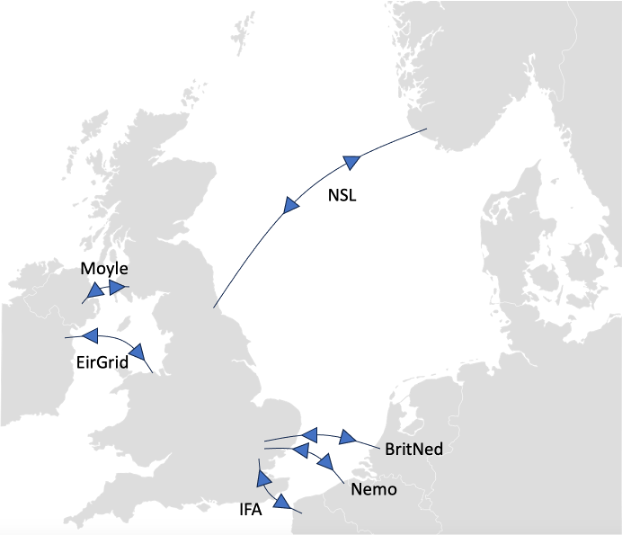
Today, the UK already has several interconnectors installed, with several more to come.
Current used interconnectors by the UK (figure: Econopolis Strategy)
Connections with Belgium, France, Ireland and Norway have already been established, with the latter being the world’s longest (720km), allowing exchange of emission free hydropower. However, the length of these cables pale in comparison to future projects. The UK has plans to connect their energy grid to Africa’s. This Xlink project proposes a 3.800 km interconnector running across the shores of Europe, all the way to Morocco. Australia and Singapore are also in talks to connect the two countries with a 4.200 km cable. Both Morocco and Australia could provide their enormous solar potential to the connected countries.
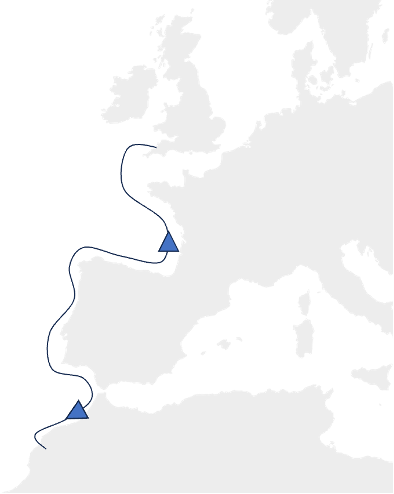
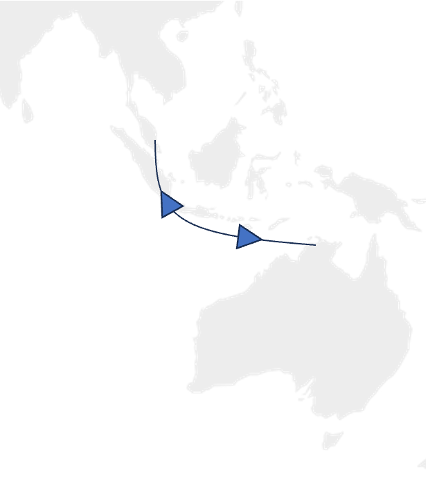
Future cable projects between Australia/Singapore and UK/ Morocco (figure: Econopolis Strategy)
There are of course a few caveats to these cables. One kilometer of cable will cost roughly € 3 million, depending on geospatial conditions. This means the projects cited above have price tags of around € 16 billion. These costs should thus enable significant cost reductions in overall energy production in order to become profitable. Furthermore, the time needed to realize these projects is rather long because the manufacturers of this niche industry can only focus on one contracted cable at a time. The needed material properties of the cables impose challenges in terms of material availability and cable robustness. Years-long delivery times and waiting lists are the natural consequence, meaning only a handful of new interconnectors can be placed any given year.
Interconnectors will play a big part in adding consistency and feasibility to the energy transition. These cables do not only connect electricity grids of countries and nations, but also connect their climate transition aspirations. In a sense, these connectors accentuate the crucial global cooperation that is needed to combat climate change effectively.