With the demand for green energy rising to enable the climate transition, all efforts go to the deployment of renewable energy. Commissioning of wind and solar energy has never been higher but, although they will undoubtedly carry the energy transition, there are still some concerns that need to be addressed. One of those concerns is the storage of the produced energy, as these natural energy carriers don’t care when we put on our washing machines. Energy supply and demand therefore don’t always coincide. Storing this energy reduces energy waste, making sure we can still benefit from wind and solar energy, regardless of when our clothes need cleaning.
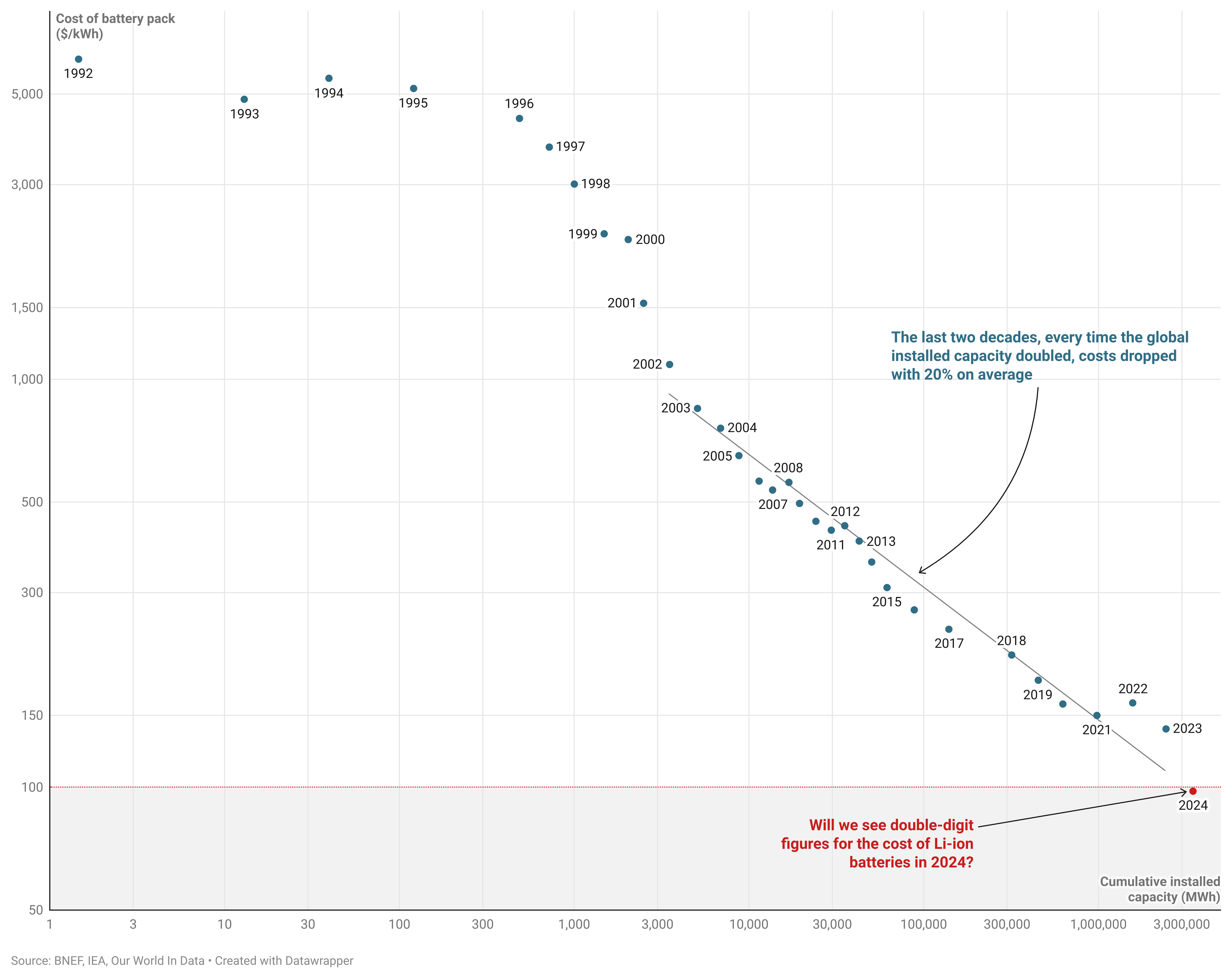
The first word that comes to mind when talking about electric energy storage is batteries. They’re in our phones, cars, laptops, and anything else that comes with a charger when you buy it. Standard lithium-ion batteries will certainly play a role in energy storage, but they have some drawbacks, as well. Their use of critical raw materials requires reusing, repurposing, and recycling to counteract possible depletion. Together with the environmental and societal impacts of the current mining paradigm, batteries are certainly not a cure-all for energy storage.
Fortunately, just like energy production, one can also rely on the forces of nature to store energy. A gravity battery is a type of electrical energy storage that converts excess electrical energy into gravitational energy. The most commonly used variant nowadays is pumped-storage hydroelectricity with a worldwide capacity of 168 GW in 2019. When energy is produced by one of our renewable sources and our washing machines aren’t turning, the electricity can be stored by pumping water from a lower basin to a higher basin. The energy is released back to the electricity grid at times of high energy demand by letting the water flow back to the lower basin through turbines. This sequence has an efficiency of 90%, which is equal to or better than batteries. However, gravity batteries have almost no environmental impact over their unlimited lifetime, which are key advantages over their lithium-ion counterpart. In general, this way of storing energy should be cheaper, an important driver for the already expensive climate transition.

Building on the idea of pumped-storage hydroelectricity, other technologies started to develop. Energy storage by rail is a concept in which heavy train cars are pushed uphill and later released, which releases the stored energy through generative breaking, much like an electric vehicle does when breaking. A reverse technology was conceptualized too: buoyant gas containers that are pulled down into water by a winch. The water naturally lifts the containers back to the surface, releasing energy in the process. The newest kid on the block, however, takes lifting and dropping things to a new level.
The Scottish company Gravitricity has plans to retrofit a Finnish mine as a full-scale prototype to demonstrate their new technology: use mining sites to lift heavy weight with excess energy and drop it back when energy is needed. The Finnish Pyhäsalmi mine with 1400-metre-deep shafts has the capacity to store 2 MW of energy. The dream of the Scottish company is to standardize this solution into mine decommissioning activities. A study by the International Institute of Applied Systems Analysis (IIASA) estimated that this technology could store up to 70 TWh of energy in abandoned mines, which is enough to meet global electricity demands. Other benefits include efficient retrofitting due to mines already being connected to the electricity grid and reduced job loss of decommissioned mines.
Gravity batteries are yet another beautiful example of using nature’s forces to enable a sustainable future. Next time you do something silly as dropping and picking something back up, you might come up with the next piece of innovation for our climate transition.