Our built environment is responsible for approximately 18% of the total emissions in our country, making our building stock a significant source of CO2 emissions. When placed in a European context, Belgium has one of the highest emissions per capita for our residential buildings. In 2018, only Luxembourg performed worse. This is not surprising: Belgians live relatively large, our building stock is old, and our homes are spread out across the country due to our spatial planning. These factors contribute to a high residential heat demand. This would not be a problem if this demand was met by clean sources. Unfortunately, today almost 90% of our residential heat is still generated by fossil fuels.
How can we address this issue? The book The Climate Shock proposes several solutions, such as district heating, deep geothermal energy, energy renovations, and heat pumps. Among these, heat pumps are particularly promising. But what exactly is a heat pump? Essentially, a heat pump transfers heat from the air, ground, or water to warm our homes, operating entirely on electricity. Remarkably, a heat pump typically produces 4 kWh of heat for every 1 kWh of electricity consumed[1]. Heat pumps thus operate on electricity, while our current boilers mainly use gas and oil. In Flanders, natural gas is particularly important due to our elaborate natural gas network.
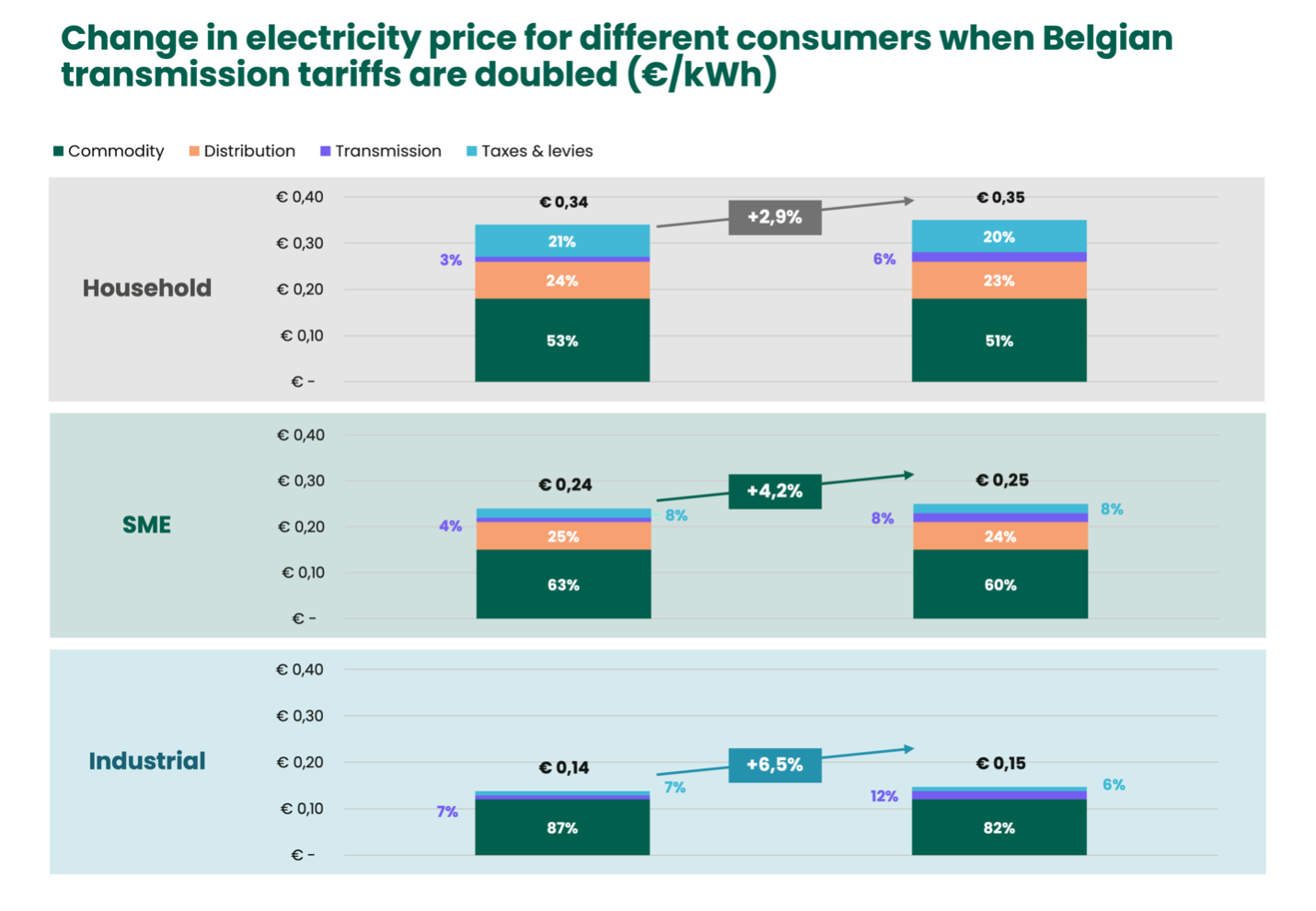
Heat pump technology can be one of the crucial clean technologies on our path to Net Zero, but today we still see some obstacles to large-scale deployment. Perhaps the most significant in our country today is the lack of economic incentives. To make heat pumps more attractive compared to gas boilers, the electricity price should not be too high relative to the gas price. This is however not the case today. Electricity is much more expensive than gas, mainly because electricity is heavily taxed compared to the fossil alternative. We highlighted this issue in an article last year[2].
Due to the Russian invasion of Ukraine, gas prices have risen much more sharply than electricity prices in recent years, resulting in a drop in the electricity-to-gas price ratio[3]. This proved to be a boost for heat pump sales. However, in 2023, the ratio has risen again. More importantly, nowhere in Europe was electricity more expensive relative to gas than in Belgium. To provide sufficient economic incentives, the electricity price should be at most 1,6 to 2,4 times higher than the gas price on average, depending on the age of the building[4]. Today, we are far above this with a ratio of 3,8, risking that heat pump sales will stall.

In order to kickstart the electrification trend on a long-term basis, we need a comprehensive policy that addresses the price discrepancy between gas and electricity. Currently, such a policy is lacking, particularly in terms of fiscal measures. The taxation imposed on electricity is comparatively higher than that on fossil fuels. Fair taxation for every energy vector would be a step in the right direction. Price signals will be a crucial instrument to get the climate transition up to speed.
[1] The efficiency of a heat pump is expressed in COP or Coefficient of Performance. It indicates the amount of kWh of heat delivered per kWh of electricity consumed.
[2] https://www.econopolis.be/en/blog/posts/2023/june/never-waste-a-good-crisis-it-is-time-for-belgium-to-lock-in-the-tumbling-electricity-to-gas-price-ratio/#_ftn2
[3] Including all taxes and levies
[4] This break-even point was defined as the electricity-to-gas price ratio at which a payback period of 15 years was assumed (heat pump vs. gas condensing boiler). A higher ratio is less beneficial for the heat pump case and will therefore increase the payback period. This point is higher for new buildings or deeply renovated buildings, as the higher efficiency results in a smaller price gap needed between power and gas. Break-even points were calculated for the Belgian climate and the Belgian state of the building stock.