In the field of transistor technology, Moore’s law has long influenced expectations. It suggests that the number of transistors that can fit on a microchip doubles approximately every two years, leading to rapid improvements in performance and cost efficiency. This principle shows how technological progress can speed up when demand for a product increases. While Moore’s law became well-known in the late 20th century, a similar trend is happening in clean energy technologies today. One of the most notable examples is the significant cost reductions in Solar PV installations over recent years. This trend of cost decline is also evident in another important clean energy technology: lithium-ion batteries.

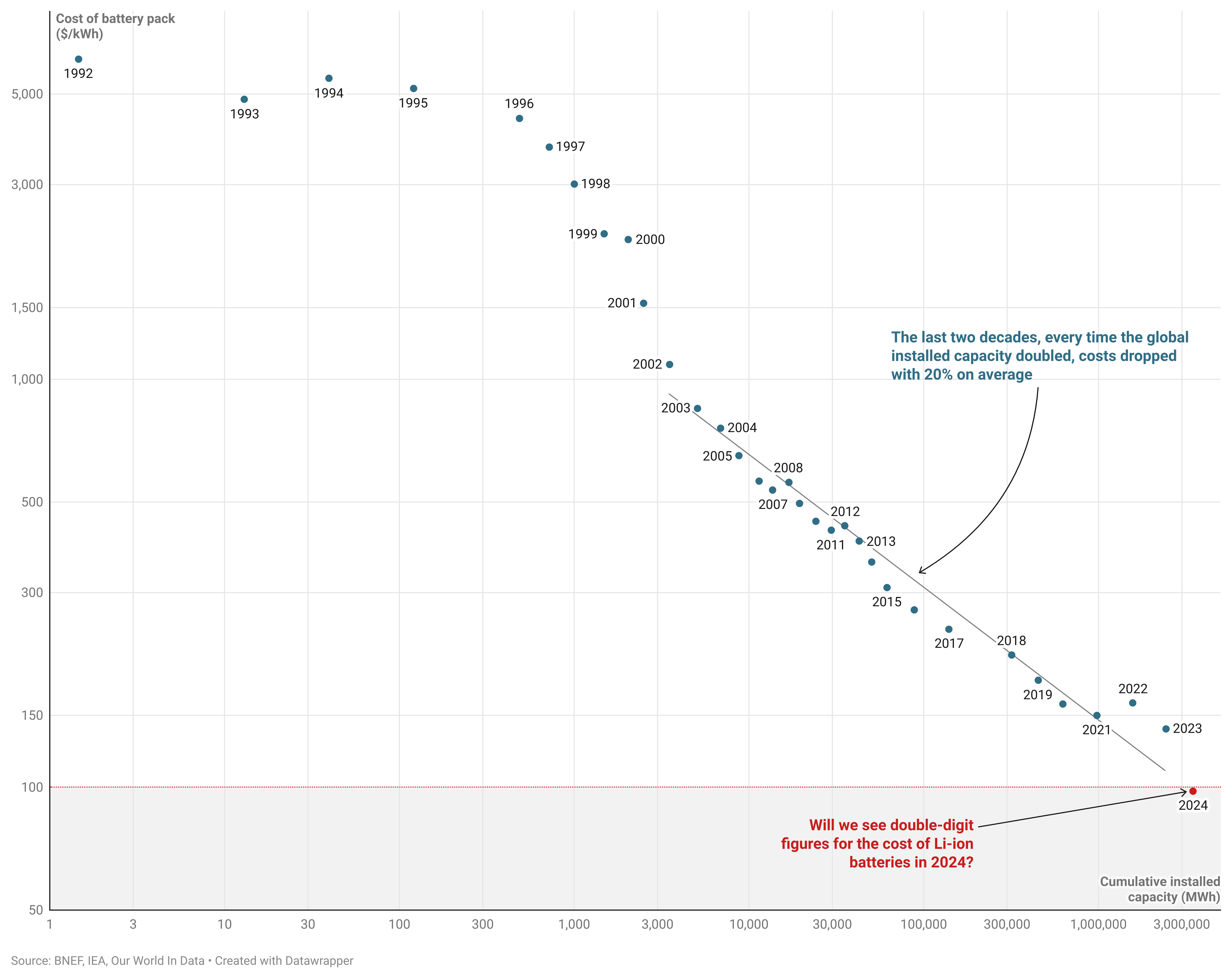
Li-ion batteries are essential for the transition to clean energy. They play a key role in electric vehicles (EVs) and provide grid-balancing services in systems with a lot of intermittent renewable sources like wind and solar. Evidence suggests that Li-ion battery technology follows a pattern like Moore’s law. Over the past decades, every time the global stock of Li-ion batteries doubled, their costs fell by an average of 20%. This promising trend makes the business case for grid balancing and battery electric vehicles (BEVs) more attractive. Following this pattern, 2024 is expected to be the year the cost of Li-ion batteries could drop below the $100/kWh threshold, a significant reduction from over $2000/kWh at the start of this century. According to the International Energy Agency (IEA), crossing this threshold is not just symbolic but also economically important, bringing BEVs closer to cost parity with fossil fuel vehicles and making them a more viable option for consumers.
While it’s too early to definitively state the average price for Li-ion batteries in 2024, the likelihood of it falling below $100/kWh is high, according to recent reports from market watchers like Volta and BloombergNEF (BNEF). Historically, advances in cost reduction for this technology have been underestimated, as was the case with solar PV and offshore wind. In 2016, the IEA projected that Li-ion battery costs would reach $100/kWh by 2040, which now appears overly conservative. As we approach this milestone, the key question shifts from whether the cost will fall below $100/kWh to how far below this threshold it will go in 2024.
In conclusion, the rapid reduction in Li-ion battery costs highlights the accelerating pace of technological advancement and its significant impact on the energy transition. As we near this double-digit day for Li-ion batteries, the implications for clean energy adoption and economic viability are substantial and encouraging.