Belgium has made notable advancements in decreasing emissions within the electricity sector by augmenting its low-carbon solar and wind energy capabilities. Nevertheless, scant attention had previously been given to evaluating the impact of intermittent generation on the electricity system. “Intermittent” refers to the fact that the wind doesn’t blow constantly throughout the day, nor does the sun shine 24 hours a day. There are moments when renewable energy generates excess energy during periods of low demand and insufficient energy during periods of high demand.
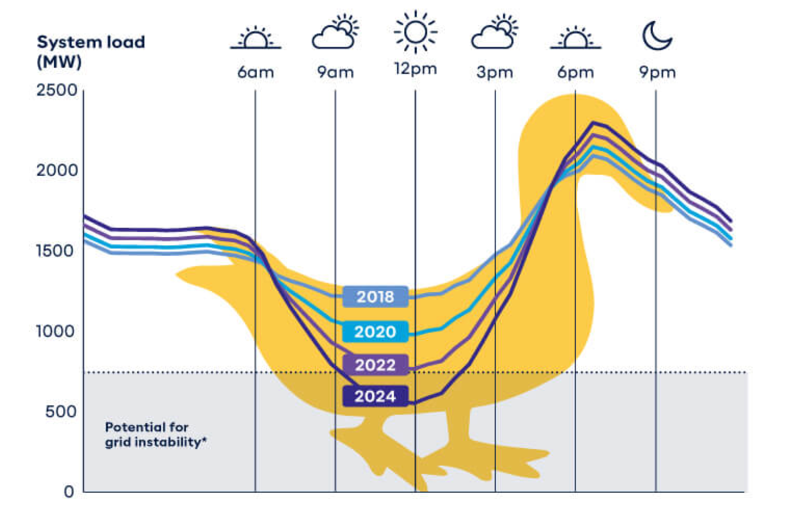
On a typical summer day, when there is a significant amount of solar production around noon, demand for electricity from the Belgian grid diminishes. This poses notable systemic implications, exemplified by the infamous “Duck Curve” graph, which depicts the electricity grid’s demand during periods of high solar energy and low demand. As can be seen on the curve, the system load – the demand that must be fulfilled by activating nuclear or gas-fired power plants – dips around noon when there is ample solar production and less demand. This curve underscores the danger of power system instability as the grid strives to manage extreme fluctuations in demand throughout the day.
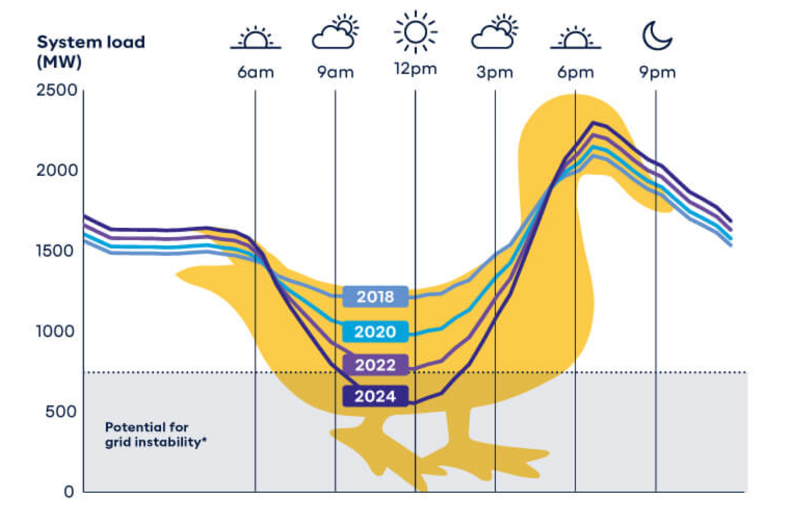
The Duck Curve during a typical summer day. Source: Synergy Australia
The Duck Curve poses a significant obstacle for grid operators on a global scale, resulting in them becoming petitioners for adaptable storage options to stabilize the grid. Thankfully, emerging energy providers have begun offering these stabilizing services and receiving compensation from the grid operator for their efforts. One such player, the British firm Centrica, has recently announced its investment in a new battery park located in the port of Ostend. The facility boasts a stabilization potential of 24 MW for the Belgian duck curve, enabling it to shift this quantity either up or down. With a storage capacity of 48 MWh, it holds the ability to supply electricity to all households in Ostend for half an hour, a seemingly brief period but often enough to offset brief spikes in system load, such as when solar panel production briefly dips due to a passing cloud. The investment is a prime example of a new generation of energy players focused solely on providing grid balancing services rather than energy production.
These new types of energy players are keeping a watchful eye on the increasing share of electric vehicles (EVs) in the Belgian fleet, as they are also coupled to the Belgian grid when charging. Infrastructure with a large stationary fleet, such as airport parking, can be useful in this regard. If one tenth of the cars parked at Brussels Airport were EVs with full capacity, the storage potential would match that of Centrica’s new battery park. With the number of EVs in the Belgian fleet rising, this presents an interesting market for new energy players to invest in. As a result, every additional EV sale contributes to mitigate the duck-ness behavior of the Belgian grid.