Undoubtedly, you may have already observed their presence on the horizon – the sturdy steel turbines situated a few dozen kilometers from our shoreline, which in the year 2022 contributed an impressive 7.5 percent to the total electricity output of our country, Belgium. Presently, their capacity stands at 2.3 gigawatts, with the potential to surge to 8 gigawatts in the future. If we expand our perspective beyond our domestic North Sea territory, the figures escalate to even greater heights. By the year 2050, Europe aims to establish up to 300 gigawatts of wind turbines in the North Sea, making the North Sea the power plant for our continent. This vision was also articulated during the North Sea Summit, held on April 24th, 2023 in Ostend, a gathering of international governmental leaders focused on advancing wind energy.
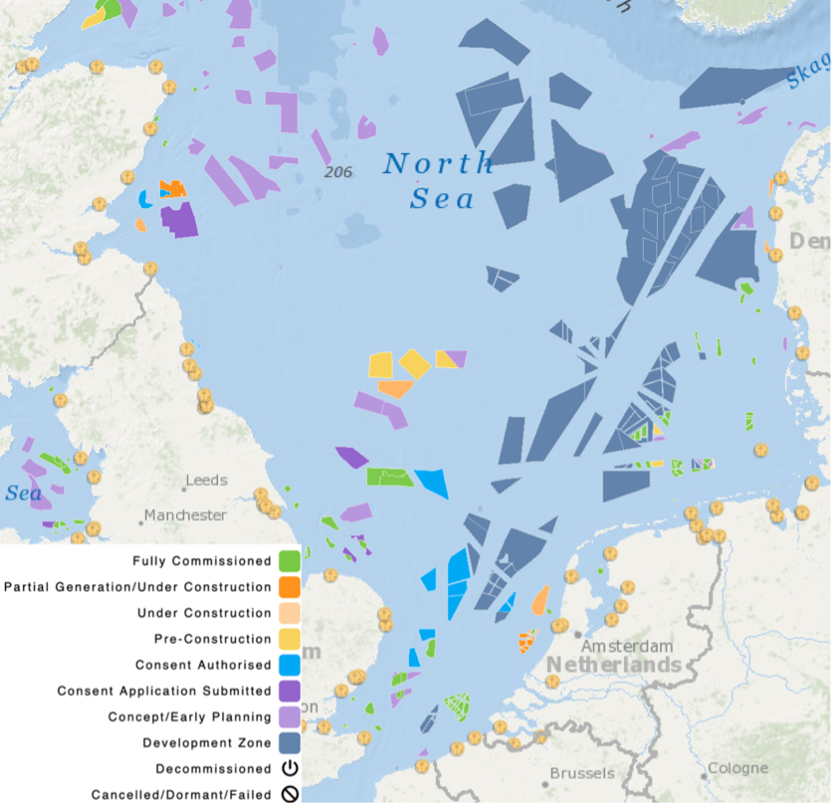
Offshore wind farms in the North Sea. Source: 4C Offshore wind
Offshore wind power is but one facet of the multi-faceted activities underway in the Belgian North Sea. We don’t realize it when we look at the wide sea view from the dike, but the Belgian Marine Spatial Plan paints a contrasting portrait of the marine space, with every corner assigned a distinct function – fisheries, future energy islands, dredging sites, military zones, nature reserves, and so forth. In the future, however, we will even move much more towards the sea. As we accelerate the construction of offshore wind turbines, we’re also exploring innovative avenues like wave and tidal energy, as well as floating solar parks. Numerous energy islands will be required to transmit this energy to shore, where electrolyzers can convert it to clean hydrogen. Seaweed cultivation is also gaining traction, while the North Sea’s depleted gas fields will be used to store large quantities of industrial CO2 emissions. Even concepts like submarine data centers are no longer science fiction!
As the range of activities expand within the “marine space”, the competition for this limited resource will intensify. The marine domain is inherently scarce, and as such, its value is set to rise significantly in the years to come. Hence, we should be smart and proactive about marine spatial planning, to ensure that we harness the full potential of our seas. We must install applications in locations where they are most viable, promote the efficient use of space through multi-purpose deployment, and foster synergies between various functions to maximize their collective impact.
How do we approach this? Although a Marine Spatial Plan is already in the works in Belgium, the mounting options make it progressively harder to assess the various trade-offs and align all the stakeholders through human cognition alone. Consequently, planning processes will increasingly require guidance from automated models that can evaluate all the trade-offs within seconds and steer the planner toward sound decisions within the marine domain.
At present, no such model exists, but this is set to change! With the support of VLAIO and the Blue Cluster, Econopolis, Mantis Consulting and ORG have embarked on a two-year project to develop a sophisticated model that will optimize the use of the marine space. This model will allow us to fill the space with activities that align with our climate objectives, such as reducing CO2 emissions. The project’s name was chosen with purpose, reflecting its critical focus: North-C-Neutral.
As the demand for marine space grows, it becomes crucial that we do not repeat the mistakes of the past when it comes to sloppy spatial planning. We are still facing the consequences of those past missteps on daily basis, such as the inefficient (public) transportation and large infrastructure projects such as Ventilus, that came to a complete standstill – there is always a backyard somewhere. To avoid these pitfalls, let us adopt a proactive approach to marine spatial planning, one that utilizes models to objectively map out all potential trade-offs. With such an approach, we can unlock the full potential of our North Sea, maximizing its value for both present and future generations.