Countries all over the world are actively cutting their emissions to reduce climate change. Policies and laws around sustainability changed in various sectors, which comes with additional efforts and of course additional funds to meet new requirements. A natural question arises: Should developing countries be held to the same standards? It’s not a secret that fossil fuels had a big impact on the enrichment of developed countries. So why should developing countries not be able to leverage their fossil fuel market to grow, after which they can partake in the green transition as a more developed country?
From a climate point of view, global restrictions on activities that enhance global warming is the way to go. But economically speaking, the image is more nuanced.
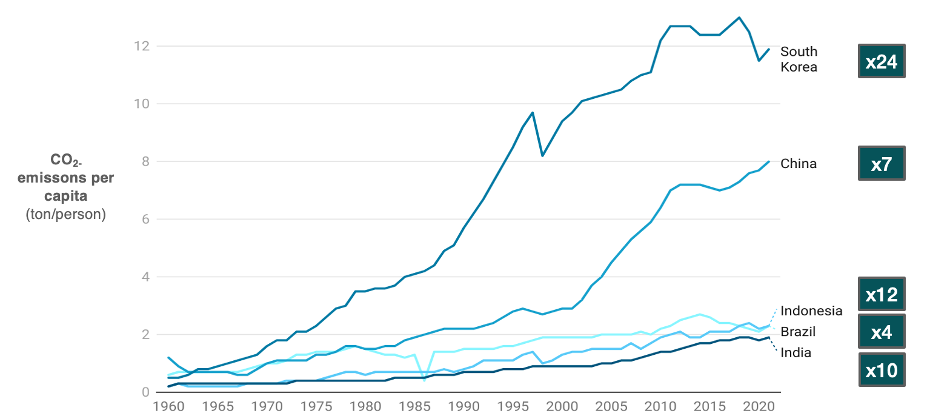
Figure: Emissions per capita from 1960 to 2021 (Source: Our World in Data)
It is often argued that typically in developing economies, per capita CO2 emissions increase dramatically in a country’s development path due to changing diets, infrastructure construction, etc. We saw that pattern, for example, with some economies that have grown substantially since the 1960s. The same pattern emerged with Western economies since the Industrial Revolution. Based on recent history, one can expect that developing countries will also emit substantially more on their path to development. Restricting emissions would seemingly imply a restriction on their economic development capacity.
There is, however, one big caveat in this extrapolative reasoning. The green transition has pushed for enormous development in renewable technologies. Nowadays, the cost of green energy is cheaper than that of fossils fuels. Where there was no cheap green alternative in the 1960’s, there is now.
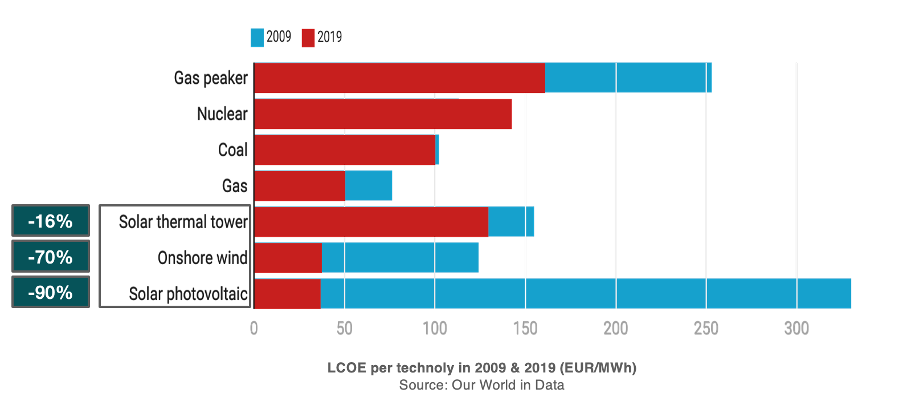
Figure: LCOE per technology; 2009 vs 2019 (Source: Our World in Data)
This means that increased energy production due to development can and should be done, according to economics, in a green way. As developing countries strive towards cost reductions in other sectors to make them more sustainable, the green alternatives will become the cheapest option. The green transition and economic development can thus go hand in hand.
Another important factor is the economic positioning of a country during the green transition. The future economy will be a green one. By pushing back the green transition, developing countries will continuously have to play catch up to new developing trends. But by embracing the green transition, they would have the chance to spearhead the green transition in certain sectors and use this as a source of economic wealth for decades to come. This trend even emerges in developed countries, where companies that didn’t jump on the green transition are now being competed out by the ones that did. And it takes immense effort to get back on top afterwards.
Global green transition is an opportunity and should be the primary focus point of every country. Not only because of climate change but also because of the economic wealth that comes with it. The main role for developed countries is to keep evolving green technologies so developing countries don’t have to choose between the transition and their own growth. If all these things are in place, the green transition is a train nobody wants to miss.