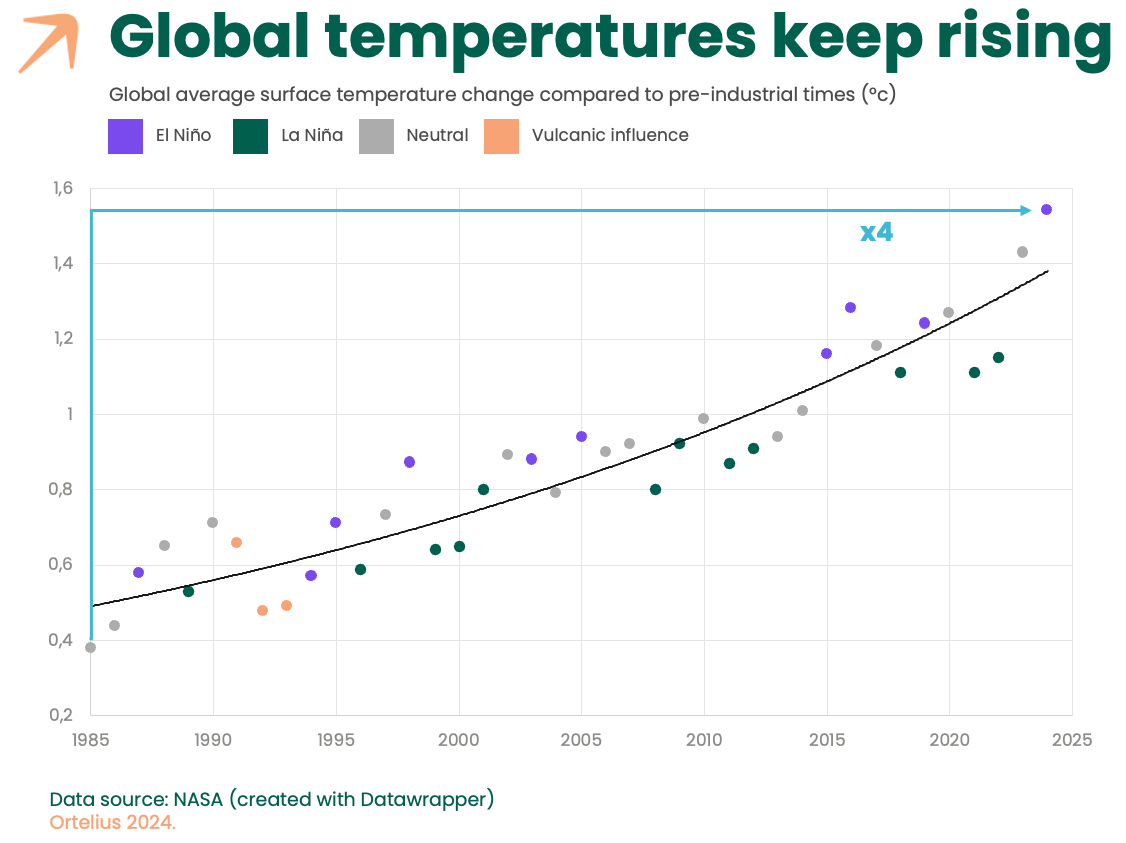
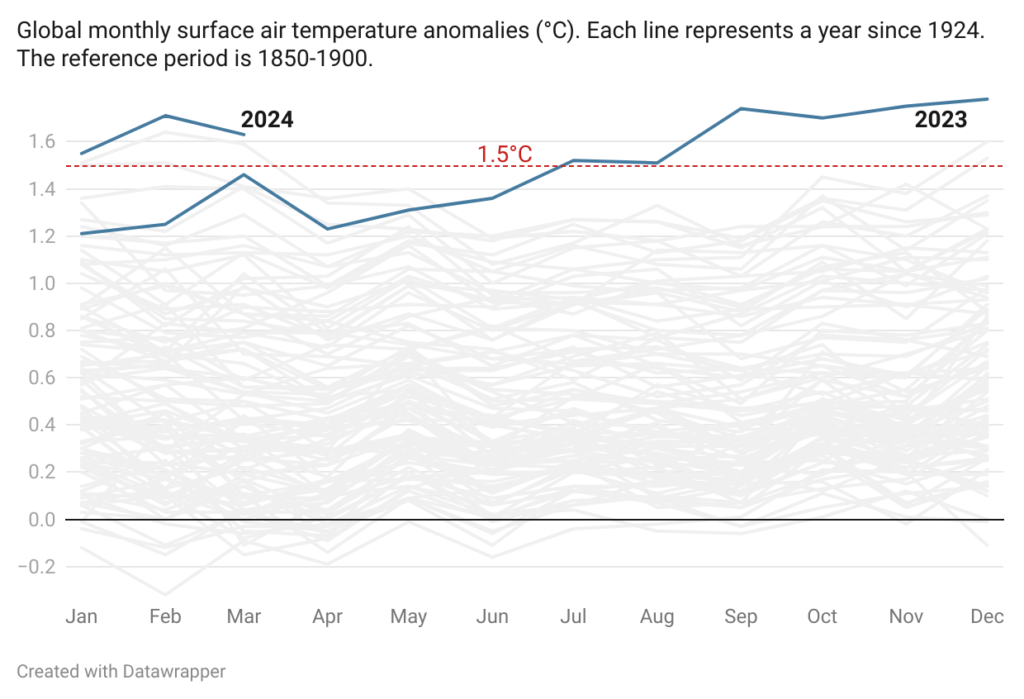
This week’s Climate Shocker could only be on one topic – a pivotal moment in our planet’s global warming trends. The latest climate bulletin of the Copernicus Climate Change Service revealed the distressing milestone that March 2024 was 1.68°C warmer than the pre-industrial (1850-1900) average for that month [1]. Even more distressing, this marked the tenth consecutive month of record-breaking temperatures for their respective times of the year. Over the last twelve months, the global average temperature has climbed to 1.58°C above the 1850-1900 baseline [1]. This rise means a breach of the crucial 1.5°C threshold set by the Paris Agreement, though it will only be considered as definitive once the change persists for a decade. Unsurprisingly, the last 12 months were warmer than any previous 12-month period, from a global perspective [1]. Nonetheless, these findings suggest a potential acceleration in global warming.
This unprecedented warming could be due to a mix of factors, none of which can explain the anomaly alone. These factors are the current El Niño event, reduced cooling from sulfur dioxide particles (concentrations of which are decreasing following pollution control measures), effects from the volcanic eruption in Tonga (January 2022), and increasing solar activity. If the situation does not stabilize by August, consistent with past El Niño patterns, we may be venturing into unexplored climate territory. In that case, this would be the largest knowledge gap in climate science of the past four decades [2].
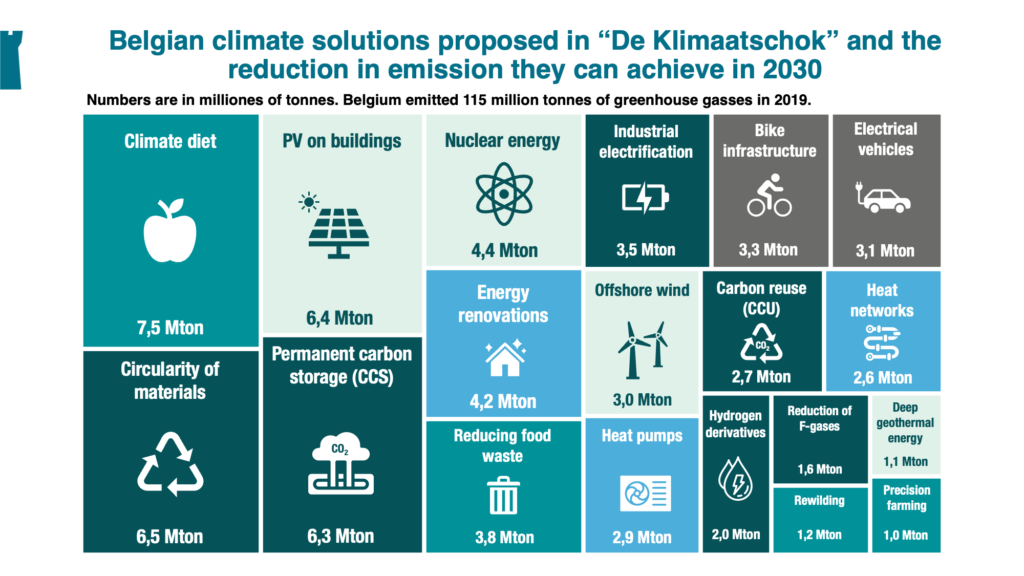
The urgency of this moment calls for immediate and diverse action, ranging from significant reductions in greenhouse gas emissions to innovative technologies that remove carbon dioxide from the atmosphere (such as Direct Air Capture), and, potentially, the consideration of geoengineering solutions. Our commitment to mitigating climate change must be as multifaceted as the challenge itself, embracing both technological advancements and policy shifts aimed at a more sustainable future. In the book ‘De Klimaatschok’, co-authored by Econopolis’ Geert Noels, Kristof Eggermont, and Yanaika Denoyelle, 20 climate solutions for the Belgian government, businesses, and citizens were proposed. The combination of these 20 solutions can lead the country to climate neutrality by 2050.
As we face the alarming trends underscored by recent climate data, let this serve as a call to action for all stakeholders. The time for decisive and comprehensive action is now. We invite you to connect with our team to explore how we can collectively address these challenges, leveraging our insights and expertise to foster a more sustainable and resilient future.
[1] https://climate.copernicus.eu/surface-air-temperature-march-2024