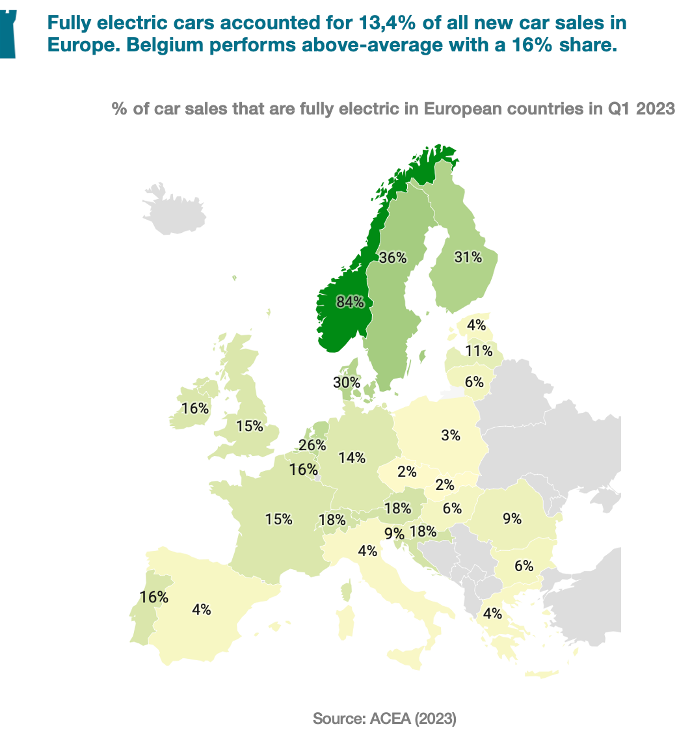
The presence of electric vehicles is increasingly noticeable on our roads. In the first quarter of 2023, fully electric cars accounted for 13,4% of all new car sales in Europe. Scandinavia traditionally leads the pack, with Norway at the forefront (84%), followed by Sweden (36,2%) and Finland (31,4%). Netherlands narrowly misses the top three with a 26% share. Belgium is performing above-average as well with a 16% share. The map below shows an overview of the percentage of passenger car sales that was 100% electric per country in the first quarter of 2023.
Electric vehicles will progressively dominate the automotive landscape in the coming decades. Presently, Belgium holds a stock of nearly 8 million vehicles, with the combined total for Belgium and the Netherlands reaching almost 18 million vehicles[1]. By 2050, an increasing number of diesel and gasoline vehicles will be replaced by electric vehicles. Consequently, a substantial volume of batteries will be in circulation, with many reaching the end of their life cycle after 10 to 15 years. While automotive batteries have stringent requirements e.g. high power output and capacity, the discarded automotive batteries can still serve a few more years in less demanding applications such as home energy storage.
What should we do with all the battery waste?
What about car batteries that are not eligible for reuse, or car batteries that eventually reach the end of their life after reuse? Well, recycling, in which we recover the batteries’ raw materials such as lithium, cobalt, aluminum, … is the way to go here. This has a range of important benefits:
- There is less pressure on (primary) raw material stocks.
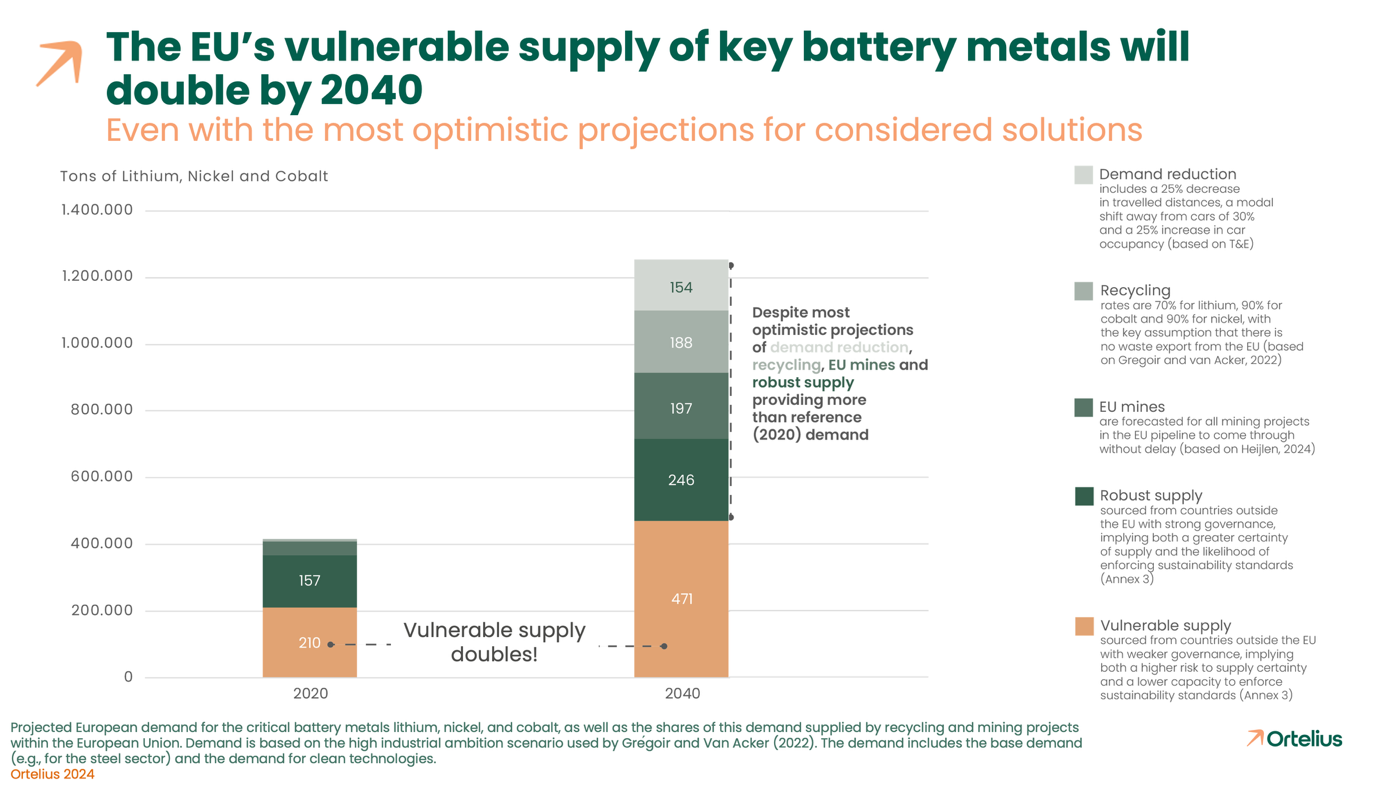
- It increases our geopolitical resilience; We will become less dependent on other countries for the supply of primary raw materials, because in the future, recycling can provide a large section of our raw material needs.
- There is a climate benefit: the extraction of primary raw materials emits more CO2 than recycling.
- There is an environmental benefit: end-of-life batteries are valorized instead of ending up in our environment as waste.
- The fast-growing recycling sector offers many economic opportunities. More on this later.
There is, however, an important remark to make. Circular or secondary resources can provide a large part of our raw material needs in the long term, but people are often too optimistic about the timing. We will still need primary raw materials for a very long time while we transition – perhaps well beyond 2050. Why is that?
- Delay effect: If a battery has a total lifespan of 15 years, and if – hypothetically – all car sales would be fully electric in 2035, this means that we can only dispose of enough end-of-life batteries in 2050 from which the recycled raw materials can be used again to produce all new cars in that year.
- Losses: However, there will always be losses in the chain, and recycling efficiencies will likely not reach 100%. Therefore, additional inflow of primary resources is needed.
- Growth: Globally, vehicle sales will probably rise due to the development of emerging economies, which means that the circular feedstock in the coming decades will not be sufficient to produce all cars in our economy. However, growth in this case is not only related to more vehicle sales but can also be due to larger batteries in the future. Again, additional primary input is needed.
Nevertheless, this doesn’t hinder our climate ambitions for 2050. Climate neutrality in 2050 is perfectly possible in a world in which we cannot yet use everything in a circular manner. In the long term, we must of course continue to strive for this.
Market potential of battery recycling
In order to gain insight in the market potential of battery recycling, Econopolis has made a stock-flow model that estimates how many batteries reach the end-of-life stage per year up to 2050, for both Belgium and The Netherlands. It not only takes passenger cars into account, but also other vehicle types such as buses or trucks. Of course, such models are always subject to numerous assumptions, but the main trend always remains the same.
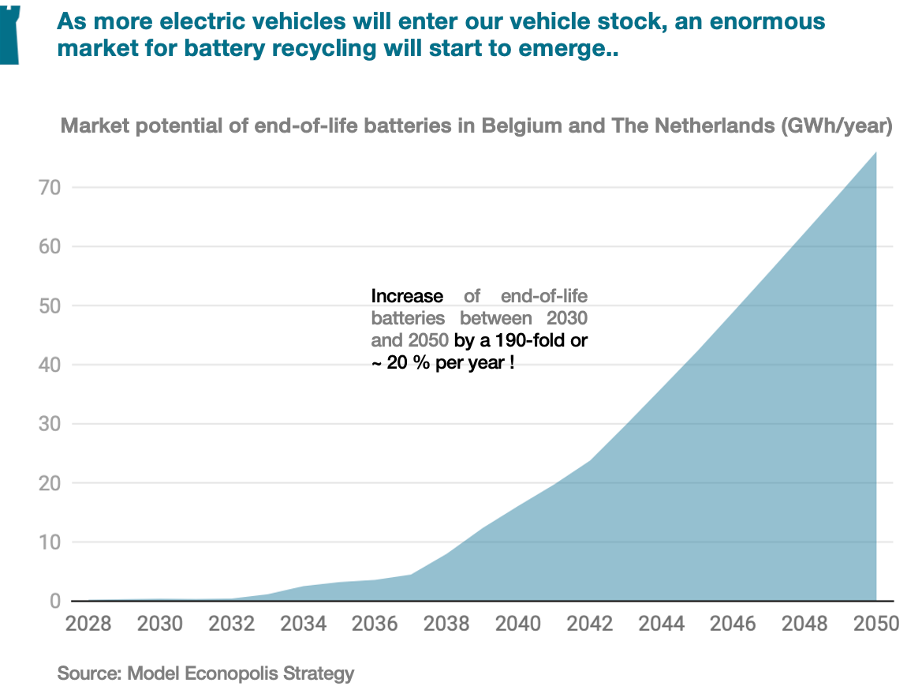
What can we learn from this figure?
- Within 10 to 20 years a huge volume of batteries will become end-of-life.
- Recycling car batteries will become an important economic activity, with a huge market potential.
But will we not just send all discarded batteries to countries like China? Well, this will probably not be the case for battery recycling. Batteries are heavy and subject to dangerous goods regulations, making them extremely expensive to transport. Since the transport costs weigh heavily in this case, local hubs are more likely to develop close to the waste sources.
This specific activity is a good example of how we should increasingly see climate transition as a source of numerous economic opportunities instead of a threat. Battery recycling can become a great new sector for our economy, and even though the large volumes can only be expected within 10 to 20 years, we should already think about how we will organize the value chain and evaluate in which knowledge domains we want to position ourselves as a region. We can be even more ambitious: battery recycling can have important spill-over effects on activities higher up in the economic chain: it can for example work as a magnet to attract high-value production activities for battery cells!
[1] When discussing vehicles, it encompasses not only passenger cars but all vehicle types (buses, trucks, delivery vans, …)