Nowadays, when it comes to placing windfarms, be it onshore or off, more and more factors need to be considered. How much energy it will produce and how costly that will be, are now accompanied by other important questions: what is the impact of the emissions coming form manufacturing? What is the impact on the environment? And so on. Commissioning windfarms has thus become a deliberation problem. Still, there are some innovative insights in windfarm development that have a positive impact on every considered aspect. A beautiful example of this is a wake modeling development out of MIT (Massachusetts Institute of Technology).
Wind turbines are always installed in so called farms for the obvious reason that it becomes economically viable by doing so. A first point of deliberation becomes clear when you look at the energy production. Maximal energy production of a turbine is achieved when it can catch wind without any turbulence. When turbines are placed one after another, they experience so called wake effects from the one that’s in front of it. Wake effects of a turbine disrupt the airflow behind it, causing the following turbines to deal with less optimal airflow, decreasing their energy production in the process.
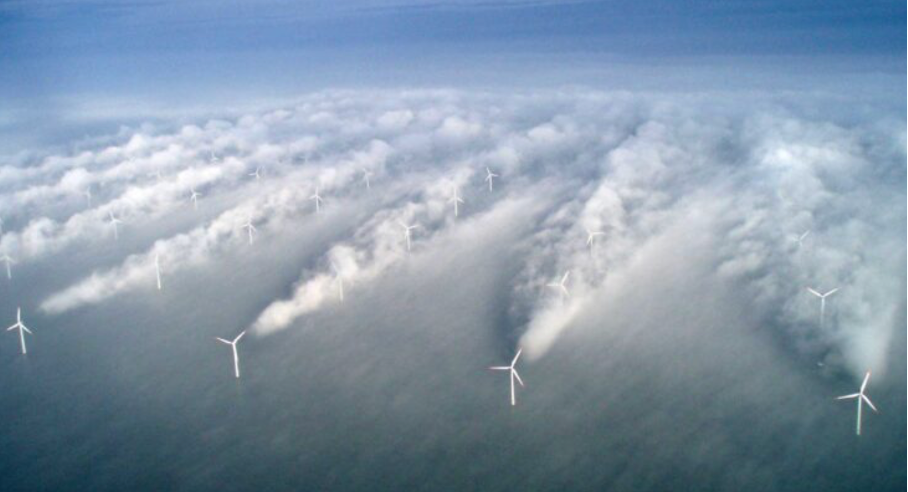
Figure: Exaggerated wake effects causing turbulent wind flow behind turbines (source: Vattenfall)
If a developer would like to maximize the energy production, it would require long distances in between turbines to mitigate those wake effects. Soon enough one realizes that this is not viable when considering ecological and economical aspects; increased distance between turbines means an increased cabling cost while the emissions of installation increase due to a larger farm size. Ecologically speaking, a larger farm size also means a larger affected area, increasing possible negative influences on habitats and biodiversity. Therefore, it seems wake effects are a necessary evil in green energy production.
With this in mind, a team at MIT started to look into a way of optimizing energy production, even with turbines placed closely together. They had the bright idea to not optimize the energy production of one turbine in a farm at a time (which is how it used to be done), but to optimize the energy production of the entire windfarm. By not turning a turbine to the most optimal position, the reduced wake effects cause the units behind to more than make up for this energy loss, resulting in a net energy gain for the entire farm. The total gained energy? Between 1% and 3%, with the latter being for optimal windspeeds. At first glance this might seem neglectable, but let’s put this into context.
Because there is no need to change hardware or position of turbines, every existing windfarm in the world can instantly implement this insight. The current wind farm fleet worldwide is around 900 GW. With the optimization of MIT, around 15 GW of extra capacity is produced. This is the equivalent of 5 Princess Elisabeth Zone offshore wind parks, with a total spatial footprint of 1400 square kilometers; almost the size of London. Extrapolating this to estimated wind farm capacity of 6000 GW in 2050, 120 GW can be saved. This amounts to 11000 square kilometers; almost the size of Flanders. The gained energy production is just one benefit. Lowering the need of additional wind farms comes with a cost reduction as well. The saved space not only protects a large area of ecosystems, but it also opens up these areas for other functionalities.
Innovative ideas like these drive the green economy to become even more sustainable. It is clear that renewable energy still has some weak spots, but by believing in our ongoing innovation, we will be ready for the needed energy transition towards 2050.
Econopolis Strategy is the economic advisor in modelling the optimal positioned for offshore wind turbines, among others, in the North-C-Neutral project.