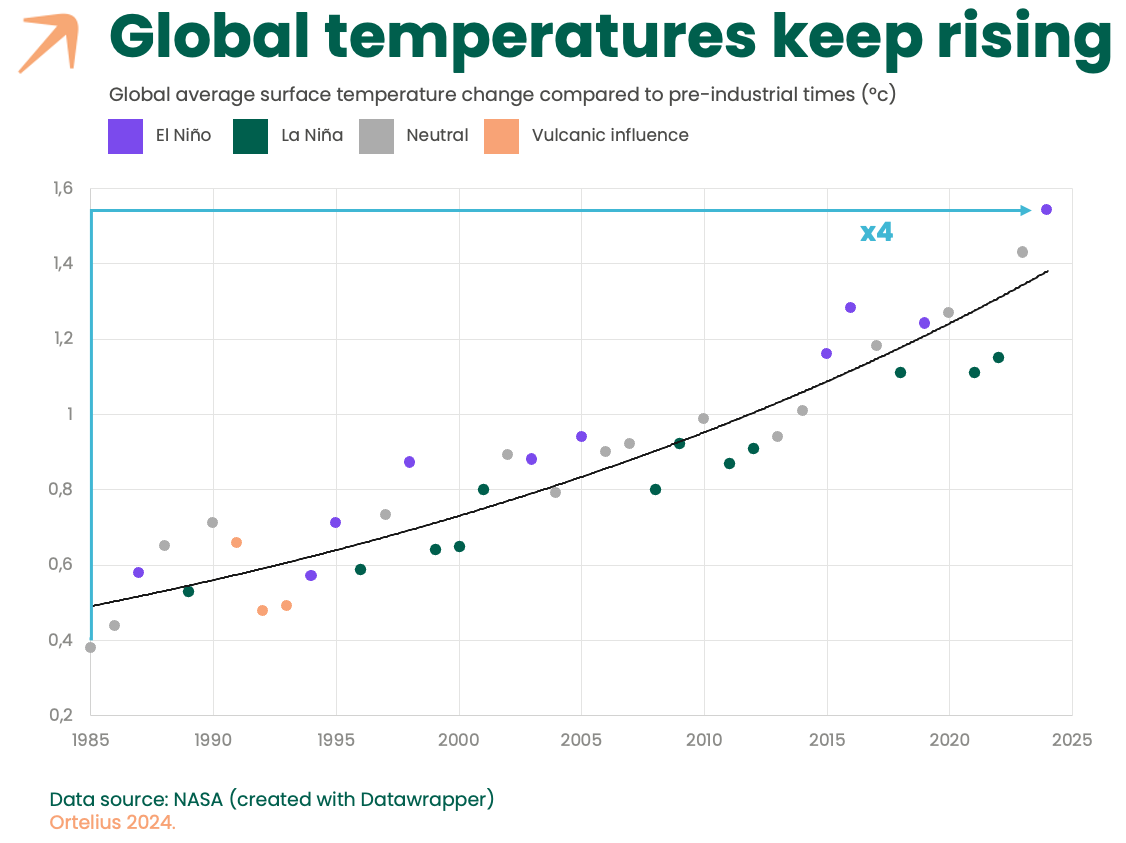
The traditional image of Belgium, with its moderate climate, has been undergoing a transformation due to the effects of climate change. While recent weeks might not have reflected this trend, the overall increase in temperatures is undeniable. This rise in temperature brings about an interesting and potentially lucrative market shift – the demand for cooling devices during the summer months.
Intriguingly, the altered climate has spurred a demand for cooling solutions that were not as critical in Belgium in the past. As heatwaves become more frequent and intense, people are seeking effective ways to combat rising temperatures. This has paved the way for a growing market in cooling devices that offer comfort and relief during hot summer months. The emergence of this market can be detected when looking at the temperature load curve of Belgium, which plots the demand for electricity as a function of the mean daily temperature. Historically, this curve exhibited a downward slope, as higher outdoor temperatures corresponded with reduced demand for heating services. Two changes are happening right now as we compare the curve from 2022 with the one from 2016. First of all, we see a decrease in overall energy consumption, thanks to improvements in energy efficiency. Secondly, we see that the uniform decrease of electricity demand with higher temperatures no longer stands. The Belgian load curve begins to exhibit a rising trend in electricity demand as higher mean daily temperatures lead to an increased need for cooling services.
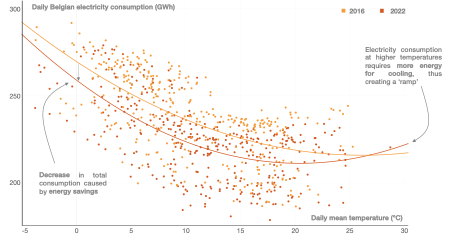
Figure 1: The Belgian temperature load curve. Based on data from ENTSO-e and IEA
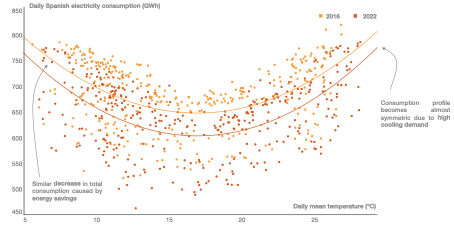
Where can this ramp take us? To gain a broader perspective, we turn our attention to Spain and examine its load curve in relation to temperature shifts. The Spanish load curve presents an intriguing contrast to the Belgian curve. Unlike the Belgian equivalent, the Spanish curve showcases a more symmetrical pattern. This pattern is primarily attributed to the nation’s higher demand for cooling services in response to elevated temperatures. The transformation of the Belgian curve into a more symmetrical pattern akin to the Spanish curve seems inevitable. The question that arises is not whether this evolution will occur, but rather when it will manifest, and to what extent. As global temperatures continue to rise, Belgium’s energy consumption patterns will likely align more closely with those of Spain, driven by the escalating demand for cooling solutions during hotter months.
Figure 2: The Spanish temperature load curve. Based on data from ENTSO-e and IEA
The shift towards a more symmetric curve in Belgium presents both challenges and opportunities that warrant careful consideration. One immediate consequence is the increased demand for heat pumping technologies. As Belgium’s need for cooling solutions rises, the market for these devices is expanding. This presents a unique opportunity for new players to enter the market, contributing to economic growth and innovation. However, it’s important to acknowledge that this growth could be hampered by supply limitations and a shortage of engineers for installation and upkeep. Policymakers need to swiftly address those concerns when raised by sector federations.
The benefits of this trend also extend beyond direct economic gains. Heat pumps, initially designed for cooling, can also be effectively utilized for heating during colder months. This dual-purpose application serves to further electrify heat demand, aligning with the broader goal of reducing reliance on traditional fossil fuels. A final benefit of this phenomenon is that the increased adoption of heat pumps can play a role in alleviating the notorious “duck curve,” a term used to describe the imbalance between electricity supply and demand caused by renewable energy sources. By driving electricity demand during peak cooling periods, heat pump technology can help mitigate the duck curve’s impact and enhance grid stability.
While the transformation of energy demand is promising, it also comes with a set of sustainability challenges. The heightened electricity demand, driven by cooling needs, must ideally be met by carbon-neutral generation technologies to align with the European Union’s ambitious environmental targets. Additionally, the increased utilization of heat pumps introduces and additional challenge involving the consumption of F-gases, potent greenhouse gases used in many heat pump systems. Addressing this challenge will be essential to ensure that the positive impact of heat pump technology is not overshadowed by its environmental drawbacks.